Google’s AI transformation is reshaping how people discover information online. Here’s what marketers, business owners, and entrepreneurs need to understand about the future of Search, SEO, GEO, and Google Ads.
How Google’s AI transformation is changing marketing
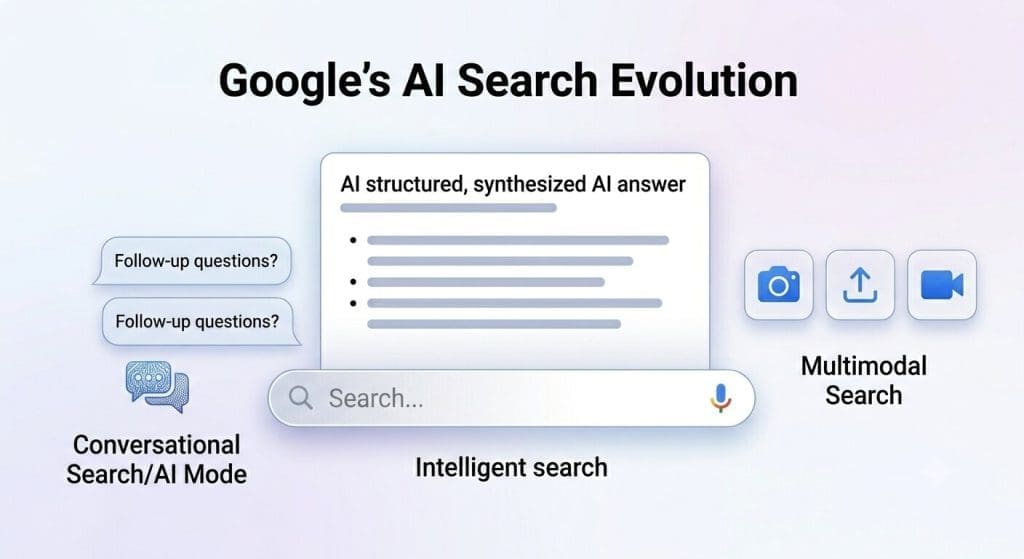
Google is currently undergoing its biggest transformation since the introduction of modern search advertising. AI-generated answers, conversational search experiences, multimodal search, and intelligent search agents are changing how people discover information online.
For businesses, marketers, and entrepreneurs, this means that traditional SEO and Google Ads strategies are evolving rapidly.
The tables below summarize some of the most important changes discussed during a recent presentation. However, they should be taken with a grain of salt. The search landscape is changing extremely quickly, and many of these developments are still evolving. The comparisons are intended to be directional and illustrative rather than absolute truths.
Google’s AI Search Evolution
| Change | What It Means |
|---|---|
| AI Overviews | Google provides an AI-generated answer above or alongside standard organic results. |
| AI Mode | A more chat-like search experience where users can ask follow-up questions and receive extended reasoning. |
| Multimodal Search Box | Google is rolling out an intelligent search box allowing users to search using text, images, files, video, and Chrome tabs. |
| Search Agents | Google launches information agents that monitor the web and deliver summarized updates. |
| Ads in AI Answers | New ad formats are being tested inside and around AI-powered search experiences. |
Google Ads: Past vs Future
| Traditional Google Ads | Future Google Ads |
| Campaigns are built around exact keywords. | Campaigns are built around problems, audiences, buyer journeys, and business outcomes. |
| Advertisers create fixed headlines and descriptions. | AI dynamically combines and adapts messages using assets, feeds, and landing pages. |
| Ads appear in classic search results. | Ads can appear in and around AI-generated experiences when relevant. |
| Campaigns are often managed channel by channel. | AI-driven campaigns can operate across multiple channels simultaneously. |

SEO vs GEO (Generative Engine Optimisation)
| Traditional SEO | Future SEO / GEO |
| Focus on ranking for specific keywords. | Focus on visibility across complete buying journeys and related questions. |
| Generic “Best X” articles. | Original research, proprietary data, case studies, comparisons, and real-world expertise. |
| Success measured by rankings and clicks. | Success measured by citations, recommendations, visibility, and business outcomes. |
| Large volumes of traffic. | Fewer but often higher-intent visitors. |
| Best optimized page wins. | Most credible, trustworthy, and useful source wins. |

What does this mean for businesses?
Businesses that continue to focus exclusively on rankings and keyword positions risk missing the broader shift happening in search.
AI systems increasingly reward content that demonstrates expertise, credibility, original insights, and real-world experience. Companies that publish unique data, customer cases, product expertise, pricing transparency, and practical guidance are likely to gain a competitive advantage as AI-powered search becomes more prevalent.
Rather than asking “How do we rank for this keyword?”, marketers should increasingly ask:
- How do we become the source AI systems trust?
- How do we help users throughout the entire decision-making process?
- How do we create information worth citing and recommending?
The answers to those questions may define the next generation of digital marketing.
Five practical actions to take right now
While nobody knows exactly how Google’s search ecosystem will evolve over the next few years, there are already several actions businesses can take to prepare.
1. Invest in expertise-driven content
AI-generated search experiences increasingly favor content that demonstrates real expertise. Generic articles created solely to target keywords are becoming less effective. Instead, businesses should focus on publishing insights that competitors cannot easily replicate, such as customer cases, proprietary data, research, industry knowledge, and first-hand experience.
2. Think beyond individual keywords
Traditional SEO often revolved around identifying a keyword and building a page around it. Going forward, businesses should consider the full customer journey: What questions does a potential buyer ask before making a decision? What concerns do they have? What comparisons are they making?
The brands that answer these questions comprehensively are more likely to become trusted sources.
3. Build brand recognition
As AI-generated answers become more common, users may click fewer links overall. This makes brand awareness increasingly important. Companies that are already known and trusted are more likely to be mentioned, cited, and selected throughout the decision-making process.
4. Measure new success metrics
Rankings and traffic remain important, but they should no longer be the only metrics that matter. Businesses should begin tracking visibility across AI-powered search experiences, share of voice against competitors, branded search demand, lead quality, and conversion performance.
5. Focus on trust
The future winners will not necessarily be those producing the most content. They will be the organizations that create the most trustworthy, useful, and verifiable content. Expertise, transparency, credibility, and evidence are becoming increasingly valuable assets in digital marketing.
Summary
The shift from traditional search to AI-assisted discovery is still in its early stages. Some predictions will prove accurate, while others will not. New features, products, and behaviors will continue to emerge at a rapid pace.
What seems increasingly clear, however, is that businesses can no longer rely solely on ranking for a handful of keywords. Success is moving toward becoming a trusted source that helps potential customers make better decisions.
For marketers, entrepreneurs, and business leaders, the opportunity is significant. The companies that adapt early may find themselves benefiting from a fundamentally new way of being discovered online.